
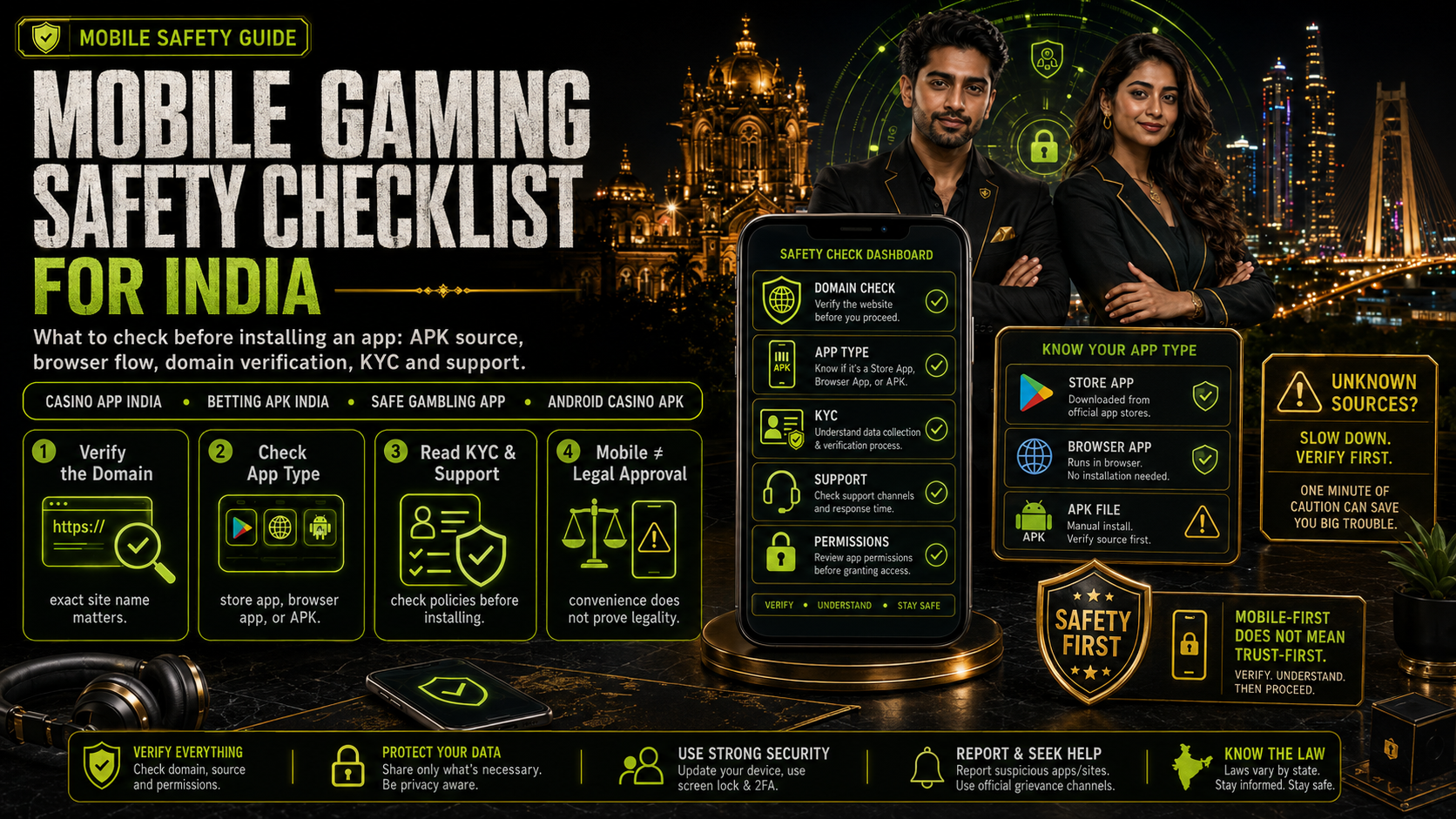
Mobile Gaming Safety Checklist for India
Mobile gaming searches are often the first step for Indian readers who want to understand casino apps, betting APKs, browser-based gaming platforms, mobile wallets, login safety, payment risks, and app-install instructions. Searches such as "casino app India," "betting APK India," "safe gambling app," "install casino app Android," and "Android casino APK" show that many users are not starting on desktop anymore. They are searching from a phone, comparing app pages, reading install guides, and deciding whether a mobile platform looks trustworthy.
That is exactly where extra caution is needed.
A mobile gaming site can look polished, fast, and professional. It may have a clean Android interface, push notifications, one-tap login, quick payment buttons, live chat, dark-mode design, and app-like navigation. But mobile convenience is not the same as safety. It does not prove that the operator is properly licensed, that the APK is secure, that withdrawals are transparent, or that the platform should be targeting Indian users.
For Indian readers, the safer approach is procedural. Before installing anything, check the domain, the operator, the app type, the KYC policy, the support routes, the payment rules, and the local legal risk. If an app asks users to bypass normal device protections, install from unknown sources, or download files outside an official store, that should be treated as a reason to slow down.
Mobile-first does not mean trust-first.
Why Mobile Gaming Safety Matters in India
India is a mobile-first market. Many users search, register, verify accounts, upload documents, contact support, and make payments from their phones. That makes mobile access convenient, but it also increases risk.
A desktop website can be checked more slowly. On mobile, users are often pushed through faster flows: install now, allow permissions, enable notifications, save login, deposit quickly, upload ID, accept bonus, continue in app. This speed can reduce careful reading.
Mobile gambling-related platforms can involve several risks at once:
- Legal risk
- APK security risk
- Fake domain risk
- Payment risk
- KYC and document-upload risk
- Privacy risk
- Withdrawal risk
- Bonus-term risk
- Responsible-gaming risk
- Support and dispute risk
A safe gambling app checklist should therefore focus on process, not appearance. A beautiful app is not proof of a reliable operation.
Mobile App, Browser App or APK: What Is the Difference?
Not all mobile gaming access works the same way. Indian readers should understand the three main formats before trusting any platform.
Store-Based App
A store-based app is downloaded through an official app store. It may go through platform-level review, although app-store presence alone does not guarantee gambling legality, fair terms, or safe withdrawals.
Browser-Based App
A browser-based mobile app works through the website. The user opens the platform in a mobile browser and may save it to the home screen. This avoids APK installation, but it still requires careful domain verification, operator checks, KYC review, and legal awareness.
Sideloaded APK
An APK is an Android installation file downloaded outside the official app store. APK installation may require users to allow installation from unknown sources. This is where caution becomes especially important because the user is manually trusting a file, a domain, and an operator.
The safest question is not "Does the app work?" The better question is: "What exactly am I installing, where did it come from, and what permissions does it request?"
Why APK Installs Need Extra Caution
An Android casino APK or betting APK can carry more risk than a normal browser visit. APK files can request permissions, store data, send notifications, track activity, and update outside standard app-store processes.
This does not mean every APK is automatically malicious. It means users should treat APK installation as a higher-risk action.
APK-related risks include:
- Downloading from a fake domain
- Installing a modified or cloned file
- Granting unnecessary permissions
- Exposing identity documents
- Saving payment or login details insecurely
- Receiving aggressive push notifications
- Bypassing app-store protections
- Installing files that are difficult to verify
- Updating through unclear channels
- Confusing official apps with mirror sites
If a platform tells users to enable unknown sources, the user should pause and verify everything twice.
Official Mobile Pages Still Require Careful Reading
Some international gambling operators publish official mobile pages, app instructions, browser-app flows, or Android download guides. These pages can help users understand how mobile products are presented, but they should not be treated as automatic proof of local safety or legality.
1xBet mobile pages have publicly promoted Android and iPhone access and discussed APK installation. That shows why readers should understand app type, download source, and install process before taking action.
Megapari mobile pages have included steps for allowing installation from unknown sources. That kind of instruction should make users especially careful because device security settings are involved.
Stake app access is commonly presented through a browser-based mobile flow. A browser-based approach may avoid sideloaded APK installation, but domain checks, policy checks, and local-law checks still remain necessary.
The key lesson is simple: mobile availability is product design. It is not legal permission, security proof, or withdrawal protection.
Step 1: Confirm the Exact Domain
The first mobile gaming safety step is domain verification.
Fake gambling domains, mirror sites, typo domains, phishing pages, cloned apps, and fake APK download pages can look convincing. A user may search for a brand name, click an ad, open a social media link, or follow a Telegram message and land on a page that looks official but is not.
Before downloading or logging in, check:
- The exact spelling of the domain
- Whether the connection uses HTTPS
- Whether the domain matches official pages
- Whether the footer shows a legal operator name
- Whether policy pages are present
- Whether support links work
- Whether the APK download page is part of the same verified domain
- Whether redirects lead to strange or unrelated domains
One wrong domain can expose login details, payment data, and identity documents.
Step 2: Check the Legal Operator Name
A brand name is not enough. A serious gaming site should disclose the legal company behind the platform.
Before installing any mobile app or APK, check whether the website shows:
- Legal operator name
- Registered company address
- Licence claim
- Regulator name
- Licence number
- Terms and conditions
- Privacy policy
- KYC policy
- AML policy
- Responsible-gaming page
- Support contact details
If a mobile page pushes installation but hides the operator, that is a serious warning sign.
A gambling app may look professional on the screen, but the real question is who controls it legally.
Step 3: Identify the App Type Before Installing
Before tapping download, users should identify whether the platform is offering:
- Official app-store installation
- Browser-based mobile access
- Progressive web app
- Android APK download
- Third-party mirror download
- Telegram or file-sharing download
- QR-code installation
The risk level changes depending on the source.
A browser-based flow may be easier to inspect because the user stays on the website. A sideloaded APK requires more trust because the file is installed on the device. A third-party download link or file-sharing source should be treated with extreme caution.
If the site does not clearly explain what is being installed, do not proceed.
Step 4: Be Careful With "Unknown Sources"
Android may warn users before installing apps from unknown sources. That warning exists for a reason.
Allowing unknown-source installation means the user is permitting apps outside the normal app-store process. If the APK is fake, modified, outdated, or malicious, the device may be exposed to security problems.
Before enabling unknown sources, ask:
- Is this the official domain?
- Is the operator clearly identified?
- Is there a licence page?
- Is there a privacy policy?
- Is there a KYC policy?
- Is customer support visible?
- Is the APK file name consistent?
- Does the site explain updates?
- Does the app request only necessary permissions?
- Can the same service be used through a browser instead?
If the answer to several questions is unclear, installation is not worth rushing.
Step 5: Review App Permissions
App permissions matter. A gaming app should not request more access than it reasonably needs.
Be cautious with permissions involving:
- Contacts
- SMS
- Call logs
- Microphone
- Camera
- Location
- Files and media
- Notifications
- Accessibility access
- Background activity
- Device administration
Some permissions may have practical uses. For example, camera access may be needed for document upload or selfie verification. File access may be needed to upload ID documents. Notifications may be used for account alerts. But permissions should still be limited and understandable.
If an app requests broad access without explanation, that is a weak safety signal.
Step 6: Read the Privacy Policy Before Uploading Documents
Mobile gambling accounts often involve KYC. Users may be asked to upload ID, PAN, address proof, payment proof, selfies, bank statements, or source-of-funds documents.
Before uploading anything from a phone, check the privacy policy.
A serious platform should explain:
- Who controls user data
- What documents may be collected
- Why documents are needed
- How data is stored
- Whether data is shared with third parties
- How long data is retained
- How users can contact privacy support
- Whether documents are uploaded through secure channels
- How identity verification is handled
A mobile app that makes document upload easy but hides privacy details is not transparent enough.
Step 7: Read KYC and AML Rules Before Installing
KYC and AML rules should be checked before registration, not only after withdrawal problems appear.
KYC means Know Your Customer. AML means Anti-Money Laundering. These rules may allow a platform to request identity documents, address proof, payment verification, selfies, source-of-funds evidence, and additional compliance information.
Mobile users often discover these rules late. They deposit first, then face verification during withdrawal.
Before installing a casino app India users should check:
- When KYC is required
- Which documents may be requested
- Whether withdrawals can be frozen during KYC
- Whether payment method must match account name
- Whether third-party payments are banned
- Whether source-of-funds checks can happen
- Whether document rejection reasons are explained
- Whether support can escalate verification issues
A platform can accept deposits quickly and still delay withdrawals until verification is complete.
Step 8: Check Payment and Withdrawal Rules
Mobile payment convenience can create a false sense of trust. A platform may show fast deposits, one-tap payments, saved cards, QR flows, wallet-like balances, crypto deposits, or instant transaction messaging. That does not mean withdrawals are equally simple.
Before using any mobile gaming platform, check:
- Minimum withdrawal
- Maximum withdrawal
- Processing time
- Payment-method restrictions
- KYC requirements
- Fees
- Manual review triggers
- Withdrawal cancellation rules
- Bonus-related withdrawal rules
- Source-of-funds requirements
- Account-freeze conditions
- Dispute route
A payment page should explain both deposits and withdrawals. If it focuses only on making deposits easy, that is not enough.
Step 9: Check Customer Support Before You Need It
Support quality should be tested before installation or registration.
Look for:
- Live chat
- Email support
- Help center
- Payment support
- KYC support
- Security contact
- Responsible-gaming contact
- Complaint process
- Dispute resolution route
- Ticket system
- Response-time information
A safe gambling app should not leave users with only a chat bubble and generic answers. Withdrawal delays, account reviews, and document disputes need written support routes.
Before installing, search the help center for "withdrawal," "KYC," "AML," "source of funds," "complaint," "self-exclusion," and "account closure." If those topics are missing, support may not be strong enough.
Step 10: Check Bonus Terms Before Accepting Mobile Offers
Mobile apps often promote bonuses with push notifications, pop-ups, banners, and limited-time offers. These can create pressure to act quickly.
Before accepting any bonus, check:
- Wagering requirements
- Playthrough formula
- Rollover rules
- Game weighting
- Excluded games
- Maximum bet limits
- Expiry time
- Minimum deposit
- Maximum cash-out
- Withdrawal restrictions
- KYC requirements
- Bonus cancellation rules
A large mobile bonus is not useful if the terms are unclear or unrealistic. Read the conditions first, not the banner.
Step 11: Avoid Fake "Guaranteed Winning" Apps
Some mobile gambling-related searches lead to predictor apps, signal groups, Aviator predictor APKs, betting tips apps, fixed-match claims, roulette systems, crash-game bots, or "guaranteed profit" tools.
These are major warning signs.
No app can reliably predict random casino outcomes. No crash-game signal tool should be treated as proof. No betting tips app can remove risk. No mobile software can turn a chance-based game into guaranteed income.
Be especially cautious with apps that:
- Promise guaranteed winnings
- Ask for payment to unlock signals
- Claim insider access
- Use fake screenshots
- Push Telegram groups
- Require side-loaded installation
- Ask for account login details
- Request remote access
- Pressure users to deposit immediately
Prediction tools are often more dangerous than ordinary gambling apps because they combine financial risk with deception.
Step 12: Understand Browser-Based App Risks
Browser-based mobile gaming avoids APK installation, but it does not remove risk.
A browser app can still involve:
- Fake domain risk
- Account theft
- Payment disputes
- KYC document exposure
- Withdrawal delays
- Bonus disputes
- Local legal risk
- Aggressive notifications
- Responsible-gaming concerns
The advantage is that the user may avoid installing unknown software. The disadvantage is that a convincing fake website can still capture login details or payment information.
For browser-based platforms, domain verification is the main safety step.
Step 13: Check for Responsible-Gaming Tools
A serious mobile gaming platform should provide responsible-gaming features that are easy to find from mobile.
Look for:
- Deposit limits
- Loss limits
- Session reminders
- Time-outs
- Cooling-off periods
- Self-exclusion
- Account closure
- Reality checks
- Responsible-gaming support
- Under-age gambling restrictions
- Links to help resources
Mobile apps can increase risk because they are always available. Push notifications, quick login, and constant access can make it harder for users to step away. Responsible-gaming tools should therefore be visible and usable from the mobile interface.
Step 14: Check Local Law Separately
This is the most important final step for Indian readers.
Mobile access does not change legal status. An app, APK, browser platform, QR code, push notification, or payment method does not prove that a platform can lawfully target users in India.
A polished app says something about product design. It says very little about local legal permission.
For India, readers should be especially cautious with real-money online casino, betting, poker, crash-game, and gambling-related app offers. Local law, operator location, offshore licensing, payment support, and mobile access are separate questions.
Do not assume that "available on mobile" means "safe to use" or "legal to use."
Mobile Gaming Safety Checklist
Use this checklist before installing or using any gambling-related mobile platform:
- Confirm the exact domain.
- Check whether the site uses HTTPS.
- Verify the legal operator name.
- Find the registered company address.
- Find the licence claim and regulator.
- Read the terms and conditions.
- Read the privacy policy.
- Read the KYC policy.
- Read the AML policy.
- Check responsible-gaming tools.
- Check whether the app is store-based, browser-based, or APK-based.
- Avoid third-party APK download links.
- Be careful with unknown-source installation.
- Review app permissions.
- Check payment and withdrawal rules.
- Check support contact options.
- Check the complaint and dispute process.
- Read bonus terms before accepting any offer.
- Avoid predictor apps and guaranteed-win tools.
- Check local law separately.
If several items cannot be confirmed, the app should not be treated as trustworthy.
Warning Signs on Mobile Gaming Pages
A mobile gaming page deserves extra caution if it shows any of these warning signs:
- No operator name.
- No licence number.
- No clear privacy policy.
- No KYC or AML policy.
- No withdrawal rules.
- Only deposit instructions.
- APK download from a third-party domain.
- Instructions to bypass security warnings without explanation.
- No responsible-gaming page.
- No support email.
- No complaint route.
- Aggressive bonus pop-ups.
- Guaranteed winning claims.
- Predictor APK offers.
- Fake celebrity endorsements.
- Unclear app permissions.
- Broken policy links.
- No local-law explanation.
A trustworthy mobile platform should not hide basic information behind install buttons.
Why Mobile Convenience Can Be Misleading
Mobile apps are designed to reduce friction. That is useful for ordinary services, but gambling-related platforms require more caution.
Fast access can make users skip the steps that matter most:
- Reading terms.
- Checking legal status.
- Reviewing KYC rules.
- Checking withdrawal conditions.
- Understanding wagering requirements.
- Verifying domain authenticity.
- Testing support.
- Reading responsible-gaming tools.
The more friction a platform removes from registration and deposits, the more carefully users should review what happens at withdrawal, verification, and dispute stages.
Key Takeaways
Mobile gaming safety in India starts with verification. Before installing a casino app, betting APK, or browser-based gaming platform, readers should confirm the domain, operator, app type, policy pages, KYC rules, payment conditions, support routes, and local legal risk.
APK installation deserves extra caution because it may require unknown-source permissions and direct trust in the downloaded file. Browser-based mobile apps avoid some installation risks, but they still require domain and policy checks.
Mobile convenience does not prove legitimacy. A polished app, fast login, push notifications, and one-tap payments do not answer the legal, privacy, withdrawal, or responsible-gaming questions.
The safest rule is simple: if a mobile gambling platform makes installation easy but verification difficult, slow down.
FAQ
This article is for informational and educational purposes only. It does not encourage gambling, betting, deposits, casino registration, app installation, or participation in online money games. Gambling can cause financial and emotional harm. Adults should follow local law, avoid risky platforms, never borrow to play, and seek help if gaming or betting stops feeling controlled.