
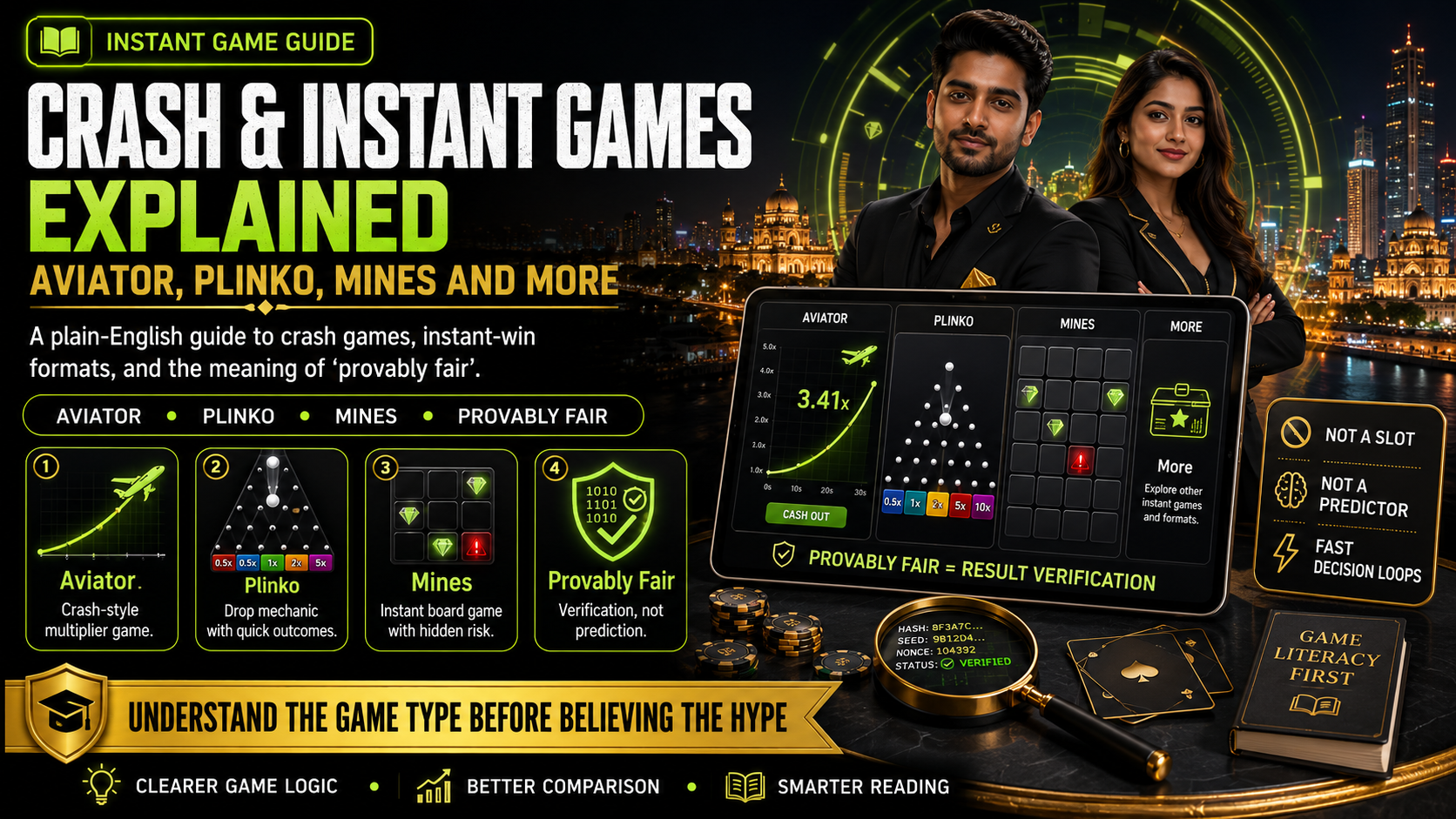
Crash and Instant Games Explained
Crash and instant games became popular because they are easy to understand, fast to load, and well suited to mobile screens. Unlike classic slot games, where the player waits for reels, paylines, symbols, and bonus features, crash and instant-win games are built around short decision loops. A round may involve watching a multiplier rise, selecting tiles on a board, dropping a ball through a grid, or making a quick decision before the outcome is revealed.
Indian readers often see these games in searches for "what is Aviator," "crash game meaning," "provably fair games," "Plinko game," "Mines game," "Aviator game," and "instant casino games." These searches usually come from curiosity, not necessarily from a clear understanding of how this product category works.
That distinction matters.
Crash games, instant games, slots, and live casino tables are different product families. They may appear on the same gaming site, but they do not work the same way. A slot is built around reel outcomes. A live table is built around streamed dealer-led or presenter-led gameplay. A crash or instant game is built around very short rounds, simplified visuals, and quick outcome mechanics.
This guide explains Aviator, Plinko, Mines, Hotline, the meaning of crash games, and the phrase "provably fair" in plain English. It is written as game-literacy content, not as a recommendation to register, deposit, or participate in real-money online money games.
What Are Crash and Instant Games?
Crash and instant games are short-format online games where the outcome is usually revealed quickly. The interface is simple, the rules are easy to explain, and the round length is often much shorter than traditional casino formats.
A crash game usually involves a rising multiplier. The multiplier increases until the round "crashes." The basic idea is that the user must understand the risk of waiting too long versus exiting earlier. The well-known Aviator game is the most common example users search for in this category.
Instant games are broader. They may include grid-based games such as Mines, drop-style games such as Plinko, or other simplified formats where the outcome is revealed through a quick visual mechanic.
The core features are:
- Short rounds
- Simple interface
- Mobile-friendly design
- Few rules compared with table games
- Fast visual feedback
- Multiplier or board-based outcomes
- Minimal waiting time
- Strong entertainment appeal
This simplicity is exactly why the category grew so quickly. But simple rules do not mean low risk, predictable outcomes, or reliable results.
Crash Game Meaning in Plain English
A crash game is an online game where a multiplier rises from a starting point and can stop, or "crash," at an unknown moment. The player's visible experience is built around that rising curve.
In plain English, the tension comes from timing. The longer the multiplier continues, the higher the displayed value becomes. But if the crash happens before the user exits the round, the outcome changes according to the game rules.
SPRIBE describes Aviator as a multiplayer game with a multiplier curve that can crash at any time. That description captures why the game became so easy to understand: watch the curve, understand the crash risk, and recognise that the decision loop is short.
However, this does not mean the outcome can be predicted. A crash game is not a skill flight simulator, not a market chart, and not a pattern game. The visual curve is part of the game presentation. It should not be treated as a reliable signal of what will happen next.
What Is Aviator?
Aviator is a crash-style game associated with SPRIBE. It is one of the most searched crash games because the concept is visually simple: a multiplier rises, and the round can crash.
The game's appeal comes from several elements:
- Simple explanation
- Short rounds
- Mobile-friendly interface
- Visible multiplier curve
- Fast result cycle
- Multiplayer-style presentation
- Easy social visibility on gaming sites
- Strong recognition in search results
Aviator is different from a slot. There are no spinning reels, paylines, scatter symbols, or traditional bonus rounds. It is also different from a live casino game. There is no live dealer controlling a physical wheel or cards. The experience is built around the multiplier curve and the crash point.
For readers, the most important point is that Aviator should not be understood through "secret pattern" logic. Claims about guaranteed Aviator strategies, predictor apps, signal groups, or fixed crash patterns should be treated with extreme caution.
Why Aviator Became So Popular on Mobile
Aviator and similar crash games fit mobile behavior very well. A user does not need to read a long rules page to understand the basic screen. The round is quick. The multiplier is visible. The interface can fit cleanly on a phone. The outcome feels immediate.
That mobile-first design explains why crash games appear in app pages, APK discussions, browser-based gaming sites, and short-form review content.
However, mobile convenience can create a false sense of control. A fast interface may make the game feel easier than it is. Short rounds can also make users underestimate how quickly repeated decisions add up.
Indian readers should separate interface simplicity from risk. A game can be easy to understand and still be highly unpredictable.
What Is Plinko?
Plinko is an instant-style game inspired by a drop-and-bounce mechanic. The visual idea is usually simple: a ball or token drops through a grid of pegs and lands in a result zone. The final position determines the outcome according to the game rules.
Plinko is popular because the visual action is easy to follow. The user does not need to understand card rankings, roulette layouts, or slot paylines. The result is shown through a physical-looking path on the screen.
But the simplicity can be misleading. The visible path does not mean the user can control the result. Plinko is not a physics skill game in the way a real-world hand-controlled game might feel. In online gaming contexts, the result follows the platform's game logic and fairness system.
Readers should look at:
- Risk level settings
- Number of rows
- Payout table
- RTP information if available
- Volatility
- Maximum and minimum outcomes
- Whether the game explains provably fair verification
- Whether the rules are transparent
Plinko should be treated as an instant outcome game with a visual drop mechanic, not as a predictable skill challenge.
What Is Mines?
Mines is an instant-style grid game. The typical concept is that a board contains hidden safe tiles and hidden mines. The user reveals tiles while trying to avoid a mine. The more safe tiles revealed, the more the risk and potential multiplier may change depending on the version.
Mines is easy to understand because the visual structure is familiar: a grid, hidden tiles, safe picks, and dangerous picks. That makes it popular in mobile-first gaming content.
However, Mines is also one of the games where users often overestimate control. A player may think that previous tiles reveal a pattern or that a certain board layout feels "due" to behave in a certain way. That is not a reliable way to understand the game.
The important factors are:
- Number of mines
- Number of safe selections
- Multiplier structure
- Cashout or stop rules
- Risk level
- Round speed
- RTP or return information
- Fairness verification claims
- Whether the game rules are clearly published
Mines is best understood as a risk-selection instant game, not as a puzzle with a guaranteed solution.
What Is Hotline?
Hotline is another instant-style title mentioned in the same broader category as Aviator, Plinko, and Mines. It belongs to the family of simple, fast games that use compact rules and short rounds rather than long slot-style animations or live dealer presentation.
For readers, the important point is not to memorise every title name. The important point is to understand the product family. Hotline, Plinko, Mines, and similar instant games are built around quick interaction, simplified visuals, and fast results.
When reading about any title in this category, ask:
- Is the game based on a rising multiplier?
- Is it based on a grid?
- Is it based on a drop mechanic?
- Is it based on hidden outcomes?
- Is it described as provably fair?
- Does the page explain RTP or house edge?
- Does the review explain risk clearly?
- Does the article avoid guaranteed-win claims?
Those questions matter more than the game's visual theme.
Crash Games vs Instant Games
Crash games and instant games are related, but they are not always the same.
A crash game usually centers on a multiplier that rises until a crash point. Aviator is the clearest example.
An instant game may include many formats: Plinko, Mines, dice-style games, wheel-style games, card reveal games, or other fast outcome products. These games may not involve a rising crash curve, but they share the same short-round structure.
The shared features are speed, simplicity, mobile focus, and quick outcomes.
The difference is the mechanic. Crash games are usually multiplier-curve games. Instant games may be board-based, grid-based, drop-based, card-based, or number-based.
Crash Games vs Slots
Crash games are often grouped near slots on gaming sites, but they are not the same product type.
Slots usually include:
- Reels
- Symbols
- Paylines or ways to win
- Wilds
- Scatters
- Bonus rounds
- Free spins
- RTP and volatility settings
- Theme-based animation
Crash games usually include:
- A rising multiplier
- A crash point
- Short round timing
- Minimal symbols
- A decision loop based on exiting or waiting
- Multiplayer-style round display
The difference matters because bad advice often comes from confusing the categories. Slot strategies, reel myths, and bonus-feature assumptions do not explain crash games. At the same time, crash-game timing myths do not explain slots.
Different game families require different literacy.
Crash Games vs Live Casino Games
Live casino games are built around streamed gameplay. A live dealer, presenter, wheel, table, or studio host is usually visible. Examples include live roulette, live blackjack, baccarat, Crazy Time, and other game-show titles.
Crash and instant games are usually more compact and interface-led. The focus is not a dealer or studio host. The focus is the immediate game mechanic.
A live game may feel slower and more social. A crash or instant game may feel faster and more direct.
This difference affects user experience. Fast rounds can make crash and instant games feel casual, but the speed can also make risk accumulate quickly.
What Does "Provably Fair" Mean?
"Provably fair" is one of the most important phrases in crash and instant game content. Readers often see it in relation to Aviator, Plinko, Mines, dice games, and other instant-style formats.
In plain English, provably fair refers to a system that allows game results to be checked through cryptographic methods. The operator or game provider is making a transparency claim about how outcomes are generated and verified.
SPRIBE says its games use provably fair cryptographic technology to verify fairness of results. That claim is about integrity and verification. It is not a claim that players can predict future outcomes.
This distinction is essential.
Provably fair does not mean "easy to win." It does not mean "profitable." It does not mean "pattern-based." It does not mean "the next result can be calculated by the player before the round." It means the game is presenting a method for checking that outcomes were generated according to a fairness system.
In educational terms, provably fair is an integrity claim, not a profitability guarantee.
What Provably Fair Does Not Mean
The phrase "provably fair" is often misunderstood. It can sound like a promise of safety or advantage. It is not.
Provably fair does not mean:
- The player can predict the next round
- The game has no house edge
- Losses cannot happen
- A strategy can guarantee profit
- A high multiplier is due
- A losing streak must end soon
- A predictor app is legitimate
- The game is legal in every country
- The platform is safe in every other way
- Withdrawals are guaranteed
- KYC will be smooth
- Local law does not matter
A game can use a fairness verification system and still be risky, volatile, and unsuitable for real-money participation.
The fairness claim should be read narrowly: it concerns result verification, not financial outcome certainty.
Why Predictor Apps and Signal Groups Are a Red Flag
Crash games often attract "predictor" claims. Readers may see Aviator predictor apps, crash signal groups, Telegram tips, guaranteed cashout signals, fixed round claims, or "secret algorithm" offers.
These should be treated as major red flags.
A game marketed as provably fair is not giving ordinary users a way to know future outcomes in advance. Anyone selling exact predictions, guaranteed multipliers, or risk-free signals is making a claim that should be viewed with suspicion.
Common warning signs include:
- Guaranteed Aviator signals
- 100% working predictor APK
- Next crash point revealed
- Fixed game access
- Admin panel method
- Secret SPRIBE algorithm
- Join paid Telegram for sure wins
- Recover losses with this bot
- Deposit through our link to activate signals
These claims are not game literacy. They are usually misleading, risky, or fraudulent.
RTP and House Edge in Crash and Instant Games
RTP stands for Return to Player. It is the theoretical long-run percentage a game is designed to return over a very large number of rounds. House edge is the opposite side of that concept.
For example, if a game has 97% RTP, the implied house edge is 3% over a very large sample.
Crash and instant games may publish RTP or fairness information, but readers should not confuse these numbers with short-term results. A game can have a published RTP and still produce long losing streaks, sharp balance swings, or unpredictable outcomes.
RTP is useful for comparison. It is not a session forecast.
The key comparison factors are:
- RTP
- House edge
- Volatility
- Round speed
- Bet structure
- Maximum multiplier
- Minimum and maximum stakes
- Fairness verification
- Rules transparency
- Responsible-gaming controls
A fast game with clear rules can still be risky because speed changes the user experience.
Why Speed Changes Risk
Crash and instant games are fast. That is part of their appeal, but it is also part of the risk.
A short round can make each decision feel small. But repeated decisions can accumulate quickly. A user may go through many more rounds in a short period than they would in a slower live table game.
Speed can affect behavior in several ways:
- Less time to think
- Faster emotional reactions
- More repeated decisions
- Stronger temptation to chase losses
- Easier mobile access
- Faster balance changes
- More reliance on patterns or feelings
- Higher risk of impulsive decisions
This is why crash and instant games should be read through a responsible-gaming lens. The product design is built for speed, and speed requires caution.
Common Myths About Aviator and Crash Games
Myth 1: Aviator Has a Secret Pattern
Crash games should not be treated as pattern charts. Previous outcomes do not reliably tell users the next crash point.
Myth 2: A Low Crash Means a High Crash Is Coming
This is a gambling fallacy. A previous low result does not guarantee a future high result.
Myth 3: Provably Fair Means Predictable
Provably fair means the results can be verified through a fairness process. It does not mean future outcomes can be predicted.
Myth 4: Predictor Apps Work
Claims about predictor APKs, signal bots, or guaranteed crash points should be treated as red flags.
Myth 5: Fast Games Are Easier to Control
Fast games can feel simple, but their speed may increase impulsive behavior.
Myth 6: Instant Games Are the Same as Slots
Instant games and slots are different product families. Slots use reel-based mechanics, while instant games use short board, drop, multiplier, or reveal mechanics.
How to Read Reviews of Crash and Instant Games
Many review pages describe crash and instant games with phrases such as easy, fast, exciting, mobile-friendly, high multiplier, simple rules, or popular in India. These descriptions may be accurate at a surface level, but they are not enough.
A useful review should explain:
- What type of game it is
- The core mechanic
- Whether it is crash, grid, drop, or reveal-based
- RTP or house edge where available
- Volatility or risk profile
- Round speed
- Maximum exposure
- Whether provably fair verification is explained
- Whether KYC and withdrawal risks are mentioned
- Whether responsible gaming is addressed
- Whether the article avoids predictor claims
- Whether local law is discussed for Indian readers
If a review only talks about "big wins," "easy gameplay," or "best strategy," it is not a serious guide.
What Indian Readers Should Notice
Indian readers should be especially careful with crash and instant game content because these titles are often promoted through mobile-first pages, APK discussions, Telegram communities, influencer clips, and short-form review articles.
The most important points are:
- Mobile access does not prove safety
- A game being popular does not prove legality
- Provably fair does not mean profitable
- Simple rules do not mean low risk
- Predictor apps are warning signs
- Fast rounds can increase impulsive behavior
- KYC and withdrawal rules still matter
- Local law remains separate from game design
In India's current online money-game environment, educational understanding should not be treated as encouragement to participate in real-money games. Game literacy is useful because it helps readers recognise risk, misleading claims, and product differences.
Crash and Instant Games Safety Checklist
Before trusting any crash or instant game review, check these questions:
- Does the article explain the game type?
- Does it define crash game meaning clearly?
- Does it explain the core mechanic?
- Does it mention RTP or house edge?
- Does it explain volatility or speed risk?
- Does it explain provably fair without exaggeration?
- Does it warn against predictor apps?
- Does it avoid guaranteed-win claims?
- Does it explain KYC and withdrawal context?
- Does it mention responsible gaming?
- Does it separate game literacy from promotion?
- Does it address Indian legal context?
If the content skips these points and focuses only on excitement, it is not a balanced guide.
Key Takeaways
Crash and instant games are fast, mobile-friendly game formats built around short decision loops. Aviator is the best-known crash game, while Plinko, Mines, Hotline, and similar titles belong to the broader instant-game family.
SPRIBE describes Aviator as a multiplayer game with a multiplier curve that can crash at any time. That makes the concept easy to understand, but it does not make outcomes predictable.
Provably fair means a game uses a verification method connected to result fairness. It is an integrity claim, not a guarantee of profit, prediction, withdrawal safety, or local legality.
Crash games are different from slots and live casino games. Slots use reel outcomes. Live tables use streamed dealer-led or host-led gameplay. Crash and instant games use very short multiplier, board, drop, or reveal mechanics.
The smartest reader habit is to classify the game first, then check rules, RTP, house edge, volatility, fairness claims, mobile safety, and responsible-gaming risks.
FAQ
This article is for informational and educational purposes only. It does not encourage gambling, betting, deposits, casino registration, app installation, or participation in online money games. Gambling can cause financial and emotional harm. Adults should follow local law, avoid risky platforms, never borrow to play, and seek help if gaming or betting stops feeling controlled.