
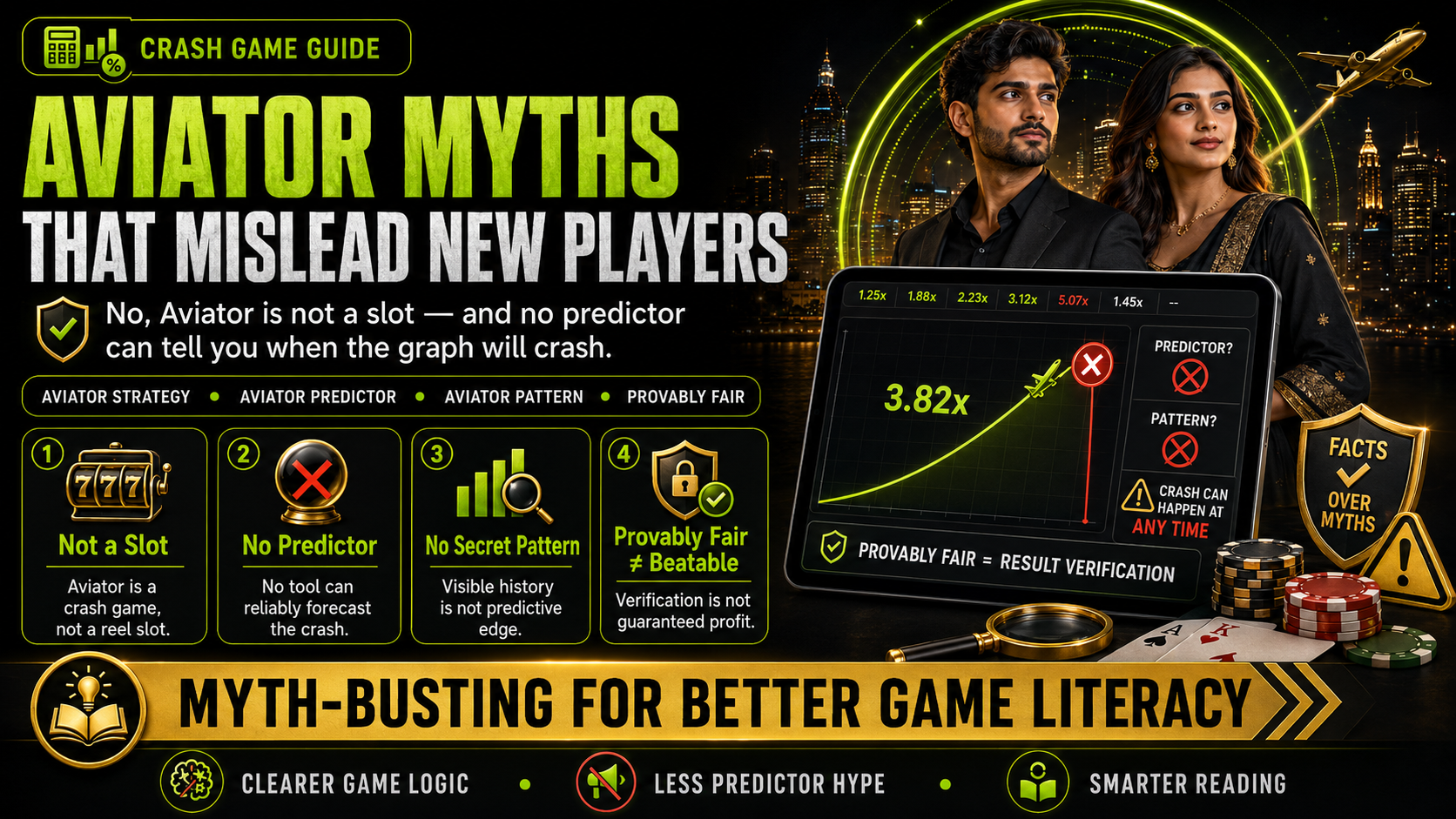
Aviator Myths That Mislead New Players
Aviator is one of the most searched crash-style games online, and that popularity has created a large amount of confusing advice. New players often search for phrases such as "Aviator strategy," "Aviator predictor," "Aviator pattern," "Aviator slot strategy," and "Aviator crash game" because they want a simple answer: is there a way to know when the graph will crash?
The honest answer is no.
The game can look like it has patterns because the multiplier moves upward, rounds happen quickly, and dramatic crashes are easy to remember. But a memorable sequence is not the same as a predictive system. A few low crashes in a row do not mean a high multiplier is due. A high multiplier appearing once does not mean the same behavior will repeat. A fast interface does not create a hidden timing advantage.
SPRIBE presents Aviator as a crash-style multiplayer game where the multiplier rises and can crash at any point. That makes it different from slots, roulette, blackjack, poker, and live casino games. The main mechanic is not reels, paylines, cards, or a dealer. It is a short crash-game loop built around a rising multiplier and an unpredictable stopping point.
This guide explains the biggest Aviator myths that mislead new players, why predictor claims should not be trusted, what "provably fair" does and does not mean, and how to read Aviator content without falling for marketing fiction.
Myth 1: Aviator Is a Slot
The first myth is basic but important: Aviator is not a slot.
A slot game is usually built around reels, paylines, symbols, wilds, scatters, bonus rounds, free spins, and a paytable. The player presses spin, the reels stop, and the result is calculated according to the slot's game model.
Aviator works differently. It is a crash-style game where a multiplier rises and can crash at any time. The visual focus is the multiplier curve, not slot reels. The player is watching a round unfold rather than waiting for symbols to align.
This distinction matters because many misleading articles use the phrase "Aviator slot strategy." That wording creates the wrong expectation. Slot myths, reel myths, bonus-round myths, and "hot slot" ideas do not explain crash games.
The better phrase is Aviator crash game, not Aviator slot.
Myth 2: There Is a Reliable Aviator Predictor
The second myth is one of the most dangerous: the idea that an Aviator predictor can tell users when the graph will crash.
There is no reliable public predictor that can tell new players the next crash point. Claims about guaranteed signals, exact multipliers, next-round forecasts, secret algorithms, or "100% working predictor APKs" should be treated as red flags.
A crash-style game can feel patterned because people remember unusual sequences. A round that crashes very early feels frustrating. A round that climbs high feels exciting. When those events happen close together, the human brain naturally tries to connect them.
That does not create predictive edge.
Memory is not mathematics. A pattern that looks meaningful after the fact is not proof that the next round can be forecast.
Myth 3: Previous Rounds Reveal the Next Crash
Many new players watch round history and try to find an Aviator pattern. They may look at previous multipliers and think a future result is becoming more likely.
Common beliefs include:
- Several low crashes mean a high multiplier is coming.
- A recent high multiplier means the next few rounds will be low.
- A sequence of similar results means the game is entering a pattern.
- A "safe" cashout point can be found by studying the last ten rounds.
- A certain time of day produces better outcomes.
These beliefs are examples of pattern-seeking behavior. They can feel convincing because the game history is visible and easy to scan. But visible history does not automatically create a prediction model.
In a crash game, previous outcomes should not be treated as a reliable map of future crashes. Reading the history panel can explain what already happened. It does not prove what will happen next.
Myth 4: A Faster Game Creates Better Timing Opportunities
Another misleading idea is that a faster version of the game gives sharper players better timing opportunities.
SPRIBE's update notes for Aviator 2.0 describe the newer version as faster and lighter for slower connections and lower-end devices. That is a product-performance improvement. It can affect loading, usability, and technical access. It does not prove that the game has become easier to beat.
A smoother interface may make the experience feel more responsive. A lighter version may work better on mobile devices. A faster connection may reduce frustration. But none of that creates a reliable crash prediction system.
Performance improvements are not the same as betting advantage.
Myth 5: "Provably Fair" Means "Beatable"
The phrase "provably fair" is often misunderstood.
In simple terms, provably fair means the game uses a verification system that allows outcomes to be checked through cryptographic-style methods. It is a transparency claim about result integrity.
It does not mean the player can predict future crashes.
It does not mean the game has no house edge.
It does not mean the next result can be calculated in advance by ordinary users.
It does not mean a predictor app can reveal the correct cashout point.
It does not mean the game is profitable.
The phrase is about verifiability, not beatability. A provably fair crash game can still be unpredictable, volatile, and risky.
Myth 6: A "Safe Cashout Point" Removes Risk
Some articles and videos claim that there is a safe Aviator strategy based on cashing out at a small multiplier every time. This may sound logical because lower multipliers appear easier to reach than very high multipliers.
But "lower risk" is not the same as "no risk."
A crash can happen early. A round can end before a chosen target. Repeated small targets can still produce losses. The game's mathematical structure does not disappear because the user chooses a conservative-looking cashout point.
A fixed cashout habit may help a person think about risk limits, but it should never be described as a guaranteed winning system. Any article promising a sure-shot Aviator strategy is overstating what strategy can do.
Myth 7: Doubling After Losses Guarantees Recovery
One of the oldest gambling myths is the recovery system: increase the next stake after a loss so that a future win recovers everything.
In crash games, this idea is especially risky because rounds are fast and losing sequences can happen quickly. A player who keeps increasing stakes after each loss can reach uncomfortable bet sizes much faster than expected.
The problem with recovery systems is simple:
- Balance is limited.
- Table or platform limits may apply.
- Losing streaks can last longer than expected.
- Emotional pressure increases.
- One more loss can become much more expensive than the first.
- The system does not change the underlying game math.
Chasing losses is not analysis. It is one of the most common paths to harmful gambling behavior.
Myth 8: High Multipliers Are Due After Low Rounds
A common Aviator pattern myth says that if several rounds crash low, a high multiplier must be coming soon.
This is a gambling fallacy. A low sequence does not create a debt that the game must repay. A crash game does not need to balance short-term results in a way that is useful to the player.
The same mistake appears in roulette, slots, baccarat, dice games, and sports betting. People see a streak and assume the opposite outcome is now more likely. But random or chance-based outcomes do not work according to emotional fairness.
The game does not know that a player is waiting for recovery.
Myth 9: Social Proof Makes a Strategy Reliable
Crash games often have a social feeling. Players may see other users, chat messages, recent results, or screenshots of high multipliers. This can create the impression that other people know something.
That impression can be misleading.
A screenshot of a high multiplier does not show all the losing attempts before it. A social media post about a big cashout does not prove the method works. A Telegram group full of confident messages does not create statistical evidence. A paid "VIP signal" channel is not automatically credible because it shows selected wins.
Social proof is powerful because it feels human and immediate. But in game analysis, selected stories are weak evidence.
The more dramatic the claim, the more careful readers should be.
Myth 10: Aviator Predictor APKs Are Legitimate Tools
Aviator predictor APKs are one of the clearest warning signs around this game category.
Any app claiming to forecast crash points, reveal hidden multipliers, connect to a secret algorithm, or provide guaranteed signals should be treated with extreme caution. These tools may expose users to several risks:
- Fake predictions
- Malware
- Phishing
- Stolen account credentials
- Payment scams
- Telegram funnel scams
- Fake screenshots
- Pressure to deposit through referral links
- Requests for device permissions
- Identity or document theft
A predictor app does not become credible because it uses technical language. Words such as algorithm, AI, server, bot, signal, hack, hash, or script do not prove that the tool works.
A serious reader should not install unknown APKs for gambling predictions.
Myth 11: A Strategy Can Remove the House Edge
Some Aviator strategy articles suggest that the right timing, stake size, or cashout plan can remove the game's mathematical disadvantage.
That is misleading.
A strategy may change the experience. It may make the user more conservative or more aggressive. It may reduce emotional decisions if used as a personal limit system. But it does not turn a crash game into a guaranteed-profit product.
The most useful role of strategy in this context is risk control, not prediction.
A responsible approach might involve understanding the rules, setting strict limits, avoiding loss chasing, and not trusting predictor claims. But that is very different from claiming that a strategy can beat the game.
Myth 12: If the Game Is Popular, It Must Be Safe
Popularity is not proof of safety.
A game can be popular because it is simple, fast, mobile-friendly, visually engaging, and widely discussed. That does not automatically mean it is suitable for every reader, legal in every jurisdiction, or safe from financial risk.
Indian readers should be especially careful with mobile-first crash-game content because it often appears alongside APK pages, predictor claims, affiliate reviews, Telegram groups, and short-form betting content. A popular search term does not remove the need to check local law, platform policies, KYC rules, payment terms, responsible-gaming tools, and dispute handling.
Aviator being well-known does not mean every page promoting it is trustworthy.
Why New Players Believe Aviator Myths
New players are especially vulnerable to Aviator myths because the game is visually simple. When a game is easy to understand, people often assume it is also easy to master.
Several factors make myths spread quickly:
- Short rounds create many visible results.
- The rising curve looks like a chart.
- People naturally search for patterns.
- High multipliers are memorable.
- Losses create a desire for recovery.
- Social media shows selected wins.
- Predictor sellers use technical language.
- Mobile apps make access feel casual.
- Review pages may focus on excitement, not risk.
The game's simplicity is part of its appeal, but it is also why misleading advice can sound convincing.
How to Read Aviator Content More Carefully
A good Aviator article should explain the product type before discussing anything else. It should clearly say that the game is a crash-style title, not a slot. It should explain that a multiplier rises and can crash at any time. It should separate provably fair verification from prediction. It should warn against predictor apps and guaranteed systems.
A weak article usually does the opposite. It may use phrases such as:
- Best Aviator strategy to win
- Guaranteed Aviator predictor
- Secret crash pattern
- 100% sure cashout point
- How to recover losses
- Easy profit method
- Fixed Aviator algorithm
- Signal group for sure wins
- Best Aviator slot strategy
These phrases are warning signs. They are usually written to attract clicks, not to educate readers.
What "Aviator Strategy" Can Honestly Mean
The phrase Aviator strategy should be used carefully. If it means "a method to predict the crash," it is misleading. If it means "a personal risk-management plan," it is more realistic.
A responsible discussion of strategy can include:
- Understanding the rules
- Knowing that outcomes are not predictable
- Setting a strict budget
- Avoiding borrowed money
- Not chasing losses
- Avoiding predictor apps
- Taking breaks
- Reading platform terms
- Understanding KYC and withdrawal rules
- Checking local legal context
- Treating the game as risk-based entertainment, not income
That type of strategy does not promise profit. It helps readers avoid worse mistakes.
Aviator and Mobile Risk
Aviator became popular partly because it fits mobile behavior well. The screen is simple, the game is fast, and the interface is easy to follow. But mobile access can increase risk because decisions happen quickly and repeatedly.
Mobile crash-game risks include:
- Faster repeated rounds
- Less time to think
- Push-notification pressure
- Easier emotional decisions
- More exposure to predictor APKs
- Telegram signal scams
- Quick deposit flows
- Difficulty reading full terms on small screens
- More impulsive loss chasing
A fast mobile interface should be treated as a reason to slow down, not as a reason to trust the game more.
Aviator, KYC and Withdrawals
Game myths are not the only issue. Readers should also understand that gaming platforms may apply account checks before withdrawals.
Even if someone understands the game mechanics, withdrawal eligibility may still depend on platform rules, KYC verification, payment ownership, bonus terms, AML checks, source-of-funds review, restricted-country clauses, and dispute handling.
This matters because many promotional pages talk about playing but do not explain what happens when a user wants to withdraw.
A serious educational article should cover both game mechanics and platform risk.
Indian Reader Context
For Indian readers, Aviator content should be approached as educational game-literacy material, not as encouragement to participate in real-money online money games.
India's online money-game environment requires caution. A game being available online, discussed in reviews, or promoted through mobile pages does not automatically mean it is lawful, safe, or suitable for Indian users.
The most important reader questions are:
- Is this article explaining or promoting?
- Does it warn against predictors?
- Does it explain crash-game mechanics clearly?
- Does it mention risk and responsible gaming?
- Does it separate provably fair from predictable?
- Does it avoid deposit pressure?
- Does it discuss local legal caution?
If the content only promises winning methods, it is not reliable analysis.
Key Takeaways
Aviator is not a slot. It is a crash-style multiplayer game where a multiplier rises and can crash at any point.
There is no reliable Aviator predictor that can tell users when the graph will crash. Predictor apps, signal groups, and secret-pattern claims should be treated as red flags.
Aviator 2.0 being faster and lighter for slower connections and lower-end devices is a product-performance point, not proof of a beatable pattern.
Provably fair means outcomes can be checked through a verification system. It does not mean future crashes are forecastable.
The most honest takeaway is simple: any article promising a secret sequence, guaranteed recovery method, or sure-shot predictor is marketing fiction, not game analysis.
FAQ
This article is for informational and educational purposes only. It does not encourage gambling, betting, deposits, casino registration, app installation, or participation in online money games. Gambling can cause financial and emotional harm. Adults should follow local law, avoid risky platforms, never borrow to play, and seek help if gaming or betting stops feeling controlled.